
Water features and spas in Cape Town
A spillover spa, a sheer descent weir or a raised edge is what separates a pool you swim in from a courtyard you sit in. All of them are structural rather than decorative, which is why they belong on the drawing before the steel is tied — retrofitting a feature into a finished pool means opening the shell, and that is a different and more expensive job than building it in.
Spillover spas
A spillover spa is a raised, heated body of water built as part of the pool structure, with its own jets and its own heater, that overflows into the main pool across a lip. Sharing the shell and the plumbing is what makes it cheaper than a standalone spa, and the constant gentle overflow is what stops it reading as a separate tub bolted onto the edge.
It also changes when the pool gets used. Cape Town has a long shoulder season either side of summer where the pool is too cold to be inviting but the evenings are perfectly pleasant to be outside in. A heated spa is the part of the installation that gets used through those months.
It needs to be designed in from the start. The spa has its own hydraulics, its own heating and its own control, and a shell built for a spa is not the same shell as one built without.
Sheer descents and other moving water
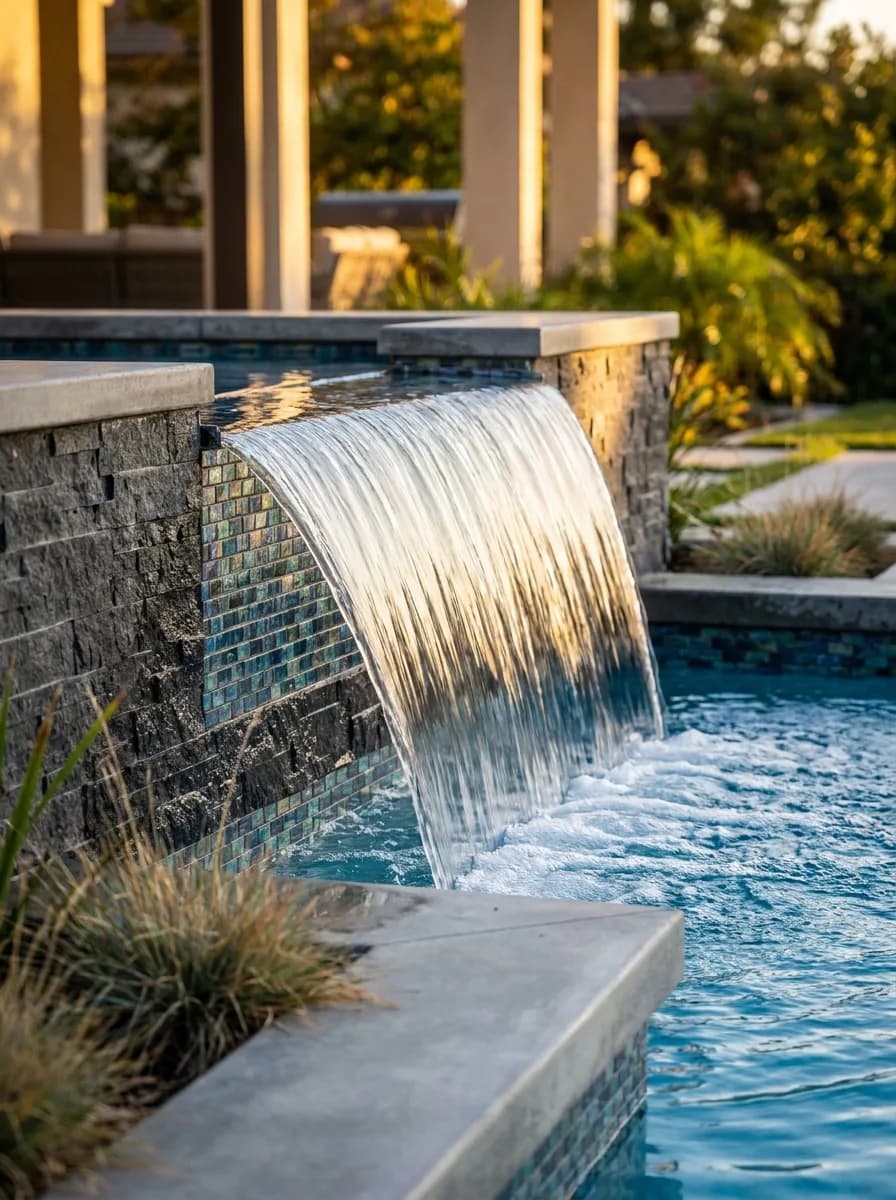
A sheer descent is a wide slot weir set into a raised wall that drops a flat, unbroken sheet of water into the pool. It is the most architectural of the water features and the one that most changes how a pool sounds — which is not a small thing on a plot near a busy road, where moving water covers traffic noise better than a wall does.
The width of the sheet and the drop height are the two decisions that matter, and they interact with the plumbing: a wider or higher sheet needs more flow to stay unbroken. Getting that wrong produces an expensive dribble, which is why it is sized on the drawing rather than adjusted afterwards.
Raised edges and infinity or wet edges are the same family of decision. They are structural walls with water behaviour attached, and they need engineering before they need cladding.
Cladding, and how it looks in Cape light
The face of a raised wall or spa is what you actually look at from the house, so the cladding choice does more visual work than anything else in the pool. Split-face and stacked stone give texture and shadow that changes through the day. Mosaic gives a wetter, more reflective surface that reads as colour.
Cape light is hard and bright for much of the year, and the sun moves a long way between summer and winter. A finish chosen indoors under a showroom light can look entirely different on a north-facing wall in January, so samples are worth looking at outside, in position, at the time of day the space is actually used.
Wind is a design input here
The south-easter is a real constraint on this kind of feature rather than a footnote. A tall thin sheet of falling water in an exposed position will blow sideways out of the pool on a windy summer afternoon, which wastes water and wets whatever is next to it.
That does not rule the feature out. It decides where it goes — sheltered by the house, by a wall or by planting — and it influences the drop height. It is one of the things worth walking the garden for, because the answer is specific to your plot and to which way the wind comes across it.