
Fibreglass pool installation in Cape Town
A fibreglass pool is a single moulded shell built in a factory, delivered whole and lowered into a prepared excavation by crane. Because the pool itself is finished before it arrives, the work on site is groundwork, placement, plumbing and commissioning rather than construction — which is why it is usually swimming inside two weeks. Fully commissioned, a fibreglass installation typically starts around R180 000.
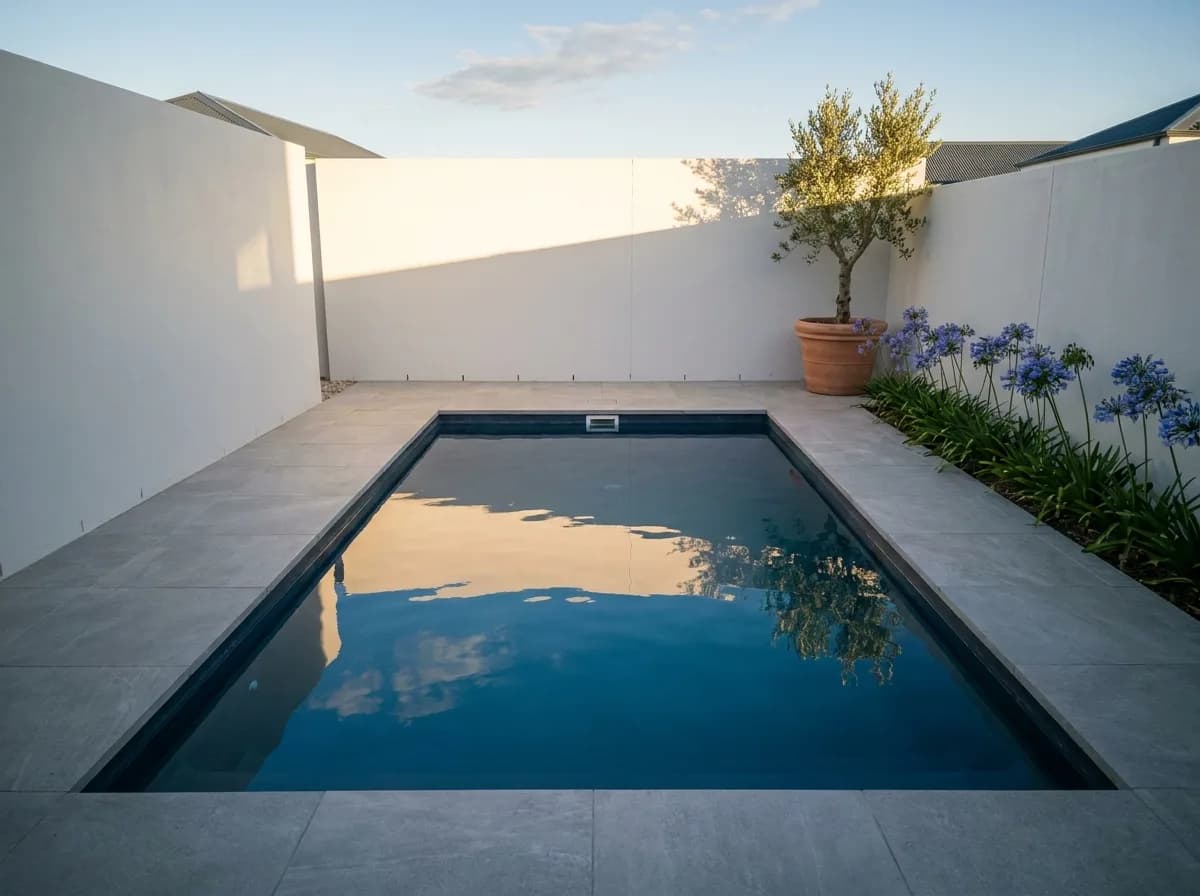
Why it is the fast option
With a concrete pool, the pool is manufactured in your garden. Steel is tied, gunite is sprayed, the shell cures, plaster goes on and cures again. Each of those stages has to finish before the next one starts, and several of them are at the mercy of the weather.
With fibreglass, all of that has already happened indoors. What remains on site is the hole, a compacted base, the shell going in, the plumbing and equipment, backfill, coping and the surrounding surface. Under two weeks is normal, and the disruption is concentrated into a much shorter window — which matters more than people expect if the pool is going into a garden you are living around.
The surface, and what it means day to day
A fibreglass shell has a gelcoat surface that is non-porous. Marbelite, by contrast, is a cement product, and cement is porous at a microscopic level — which gives algae texture to grip. That single difference is the reason a fibreglass pool generally holds its water balance with less chemical input and less brushing than a plastered pool of the same size.
The same smoothness is why it is the more comfortable surface underfoot, particularly on steps and on the floor of the shallow end, where marbelite in an older pool tends to go rough first.
The trade-off is honest and worth stating plainly: you are choosing from shapes that already exist. Moulds are fixed, so the length, width, depth and step arrangement come as a set. If the site allows one of those shapes, fibreglass is usually the better-value answer. If it does not, no amount of wanting it to work will make the shell fit.
What the site has to allow
Two things decide whether a site is suitable, and both are worth checking before anyone falls in love with a brochure. The first is delivery: the shell is a rigid object several metres long and it has to travel from the truck to the hole in one piece. The second is the crane, which needs somewhere stable to set up within reach of the excavation.
That combination rules out some Cape Town plots — steep drops behind the house, tight side passages, overhead power lines, a neighbour's mature tree directly over the lift path. It is the first thing looked at on the site visit, because there is no point pricing a shell that cannot physically be delivered.
Ground still matters even though the shell is pre-made. The excavation needs a properly prepared and compacted base, and on the sandy West Coast soils around Table View and Bloubergstrand the sides of the dig need support while the shell is positioned. Backfilling is done in stages against a filling pool so the water pressure inside and the fill pressure outside stay in balance.
Approval still applies
A fibreglass pool needs approved building plans from the City of Cape Town in exactly the same way a concrete one does, and the safety barrier must meet SANS 10134. The speed of the installation makes no difference to the paperwork, and the drawings are prepared and submitted as part of the job.