
Concrete pool construction in Cape Town
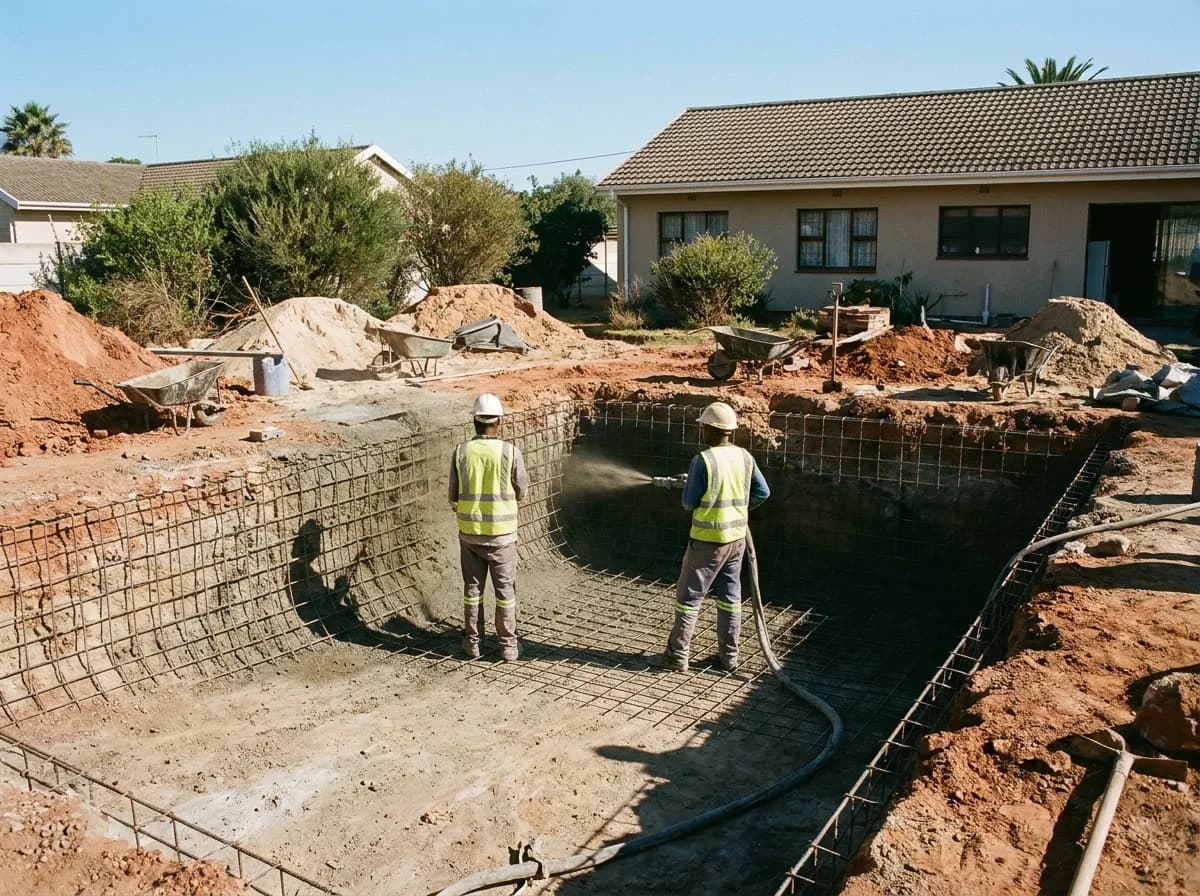
A concrete pool is sprayed, not poured. Steel reinforcing is tied to the shape of the hole, then gunite is applied under pressure to form a single monolithic shell that takes any geometry you can draw. In Cape Town that flexibility is often the deciding factor rather than a luxury: a moulded shell needs a rectangle of flat, accessible ground, and a great many Cape plots do not have one. Concrete starts from around R280 000 and runs six to ten weeks from excavation to handover.
What gunite actually is
Gunite is a dry mix of cement and sand blown through a hose, with water added at the nozzle by the operator. It leaves the nozzle fast and packs itself against the steel, which is why it can be applied to a vertical wall or an overhanging curve without formwork and without slumping. The shell it forms is one continuous piece of concrete rather than panels joined together, and there is no seam anywhere in it for water to find.
The steel underneath is what does the structural work. Reinforcing bar is bent and tied to the excavated profile, sized and spaced to suit the depth of the pool and the ground it sits in, and signed off by an engineer before any concrete is sprayed. That drawing is what the ten-year structural guarantee is written against.
Once the shell has cured it is finished. Marbelite — a cement plaster with crushed marble through it — is the standard choice and gives the soft matte surface most people picture when they think of a South African pool. Full tiling or a mosaic waterline costs more and takes longer, but it is the finish that lasts longest before it needs attention.
Why Cape Town plots so often need concrete
A fibreglass shell arrives on a truck and goes in with a crane. That works beautifully on a flat, open site with a driveway wide enough for both. It works far less well on a steep Atlantic Seaboard erf where the garden is three metres below the street, on a narrow Southern Suburbs plot hemmed in by neighbours and mature oaks, or anywhere the only approach is a side passage.
Concrete has no such constraint, because it arrives as materials rather than as an object. Where the site is awkward, the pool is built to fit the awkwardness — narrow and long down the side of a house, wrapped around an existing terrace, stepped into a slope with a raised wall on the low side.
It also removes the shape compromise. A moulded shell comes in fixed sizes and depths, so on a constrained site you are frequently choosing between a pool that fits and a pool you actually want. A sprayed shell is drawn to the space that exists.
Ground conditions across the Cape
Ground is the single biggest variable in what a pool costs to build, and it changes considerably across the metro. The West Coast strip — Table View, Bloubergstrand, Milnerton — is deep windblown sand. Sand excavates quickly and cheaply, but it does not hold a vertical face, so the sides of the hole need support while the steel goes in, and a high summer water table in places can mean dewatering during the build.
The Southern Suburbs and the Constantia valley are a different problem: clay and decomposed granite, sometimes with rock inside the dig. That ground stands up on its own, which simplifies the excavation, but clay swells when it takes on water and shrinks again when it dries, and a shell has to be designed to sit calmly through that annual cycle rather than fight it.
The Atlantic Seaboard is mostly rock on a slope. Rock means breaking rather than digging, which is slower and noisier and shows up as a real line on the quote. It is also why the honest answer to what a pool costs cannot be given over the phone — the same pool on two plots a kilometre apart can differ by a meaningful sum purely on what is under the grass.
Plans, approval and the safety barrier
In the City of Cape Town a swimming pool needs approved building plans. Drawings are prepared and submitted on your behalf as part of the build rather than left with you to arrange, and the approval runs in parallel with the early site work so it is not sitting in the way at the end.
The barrier around the pool must meet SANS 10134, the national standard covering safety barriers for private swimming pools. It is a legal requirement rather than a recommendation, and it is worth settling early: where the fence or wall runs changes the usable shape of the garden, and it is far cheaper to decide that on the drawing than after the coping is laid.